
What Is Affiliate Marketing and How Does It Work?
What the word affiliate means, who is involved in an affiliate deal, and how an affiliate program works step by step, from the first click to the payout.
Affiliate marketing is a performance-based partnership: a company pays you a commission when someone you referred buys, signs up or takes another agreed action. No sale or action, no payout. That simple rule is why affiliate programs power a large share of online sales, from software and finance to dating, gaming and e-commerce.
This guide explains what the word affiliate means, who is involved, and how an affiliate program works step by step. Key terms link to our affiliate marketing glossary, so you can look up anything that is new to you.
What does "affiliate" mean?
The word comes from the Latin affiliare, "to adopt as a son". In everyday English an affiliate is a person or company officially connected to a larger organization, like a local TV station affiliated with a national network.
In online marketing the word has a narrower meaning. An affiliate (also called a publisher or partner) is an independent person or business that promotes another company's products and earns a commission for each result they bring. The affiliate is not an employee and does not own the product. They own the audience: a website, an email list, a social account, a YouTube channel or paid ad campaigns.
You will see the word used in three ways:
- Affiliate — the partner who promotes ("I'm an affiliate for this VPN").
- Affiliate marketing — the whole model of paying partners for results.
- Affiliate program — the set of rules, tracking and commissions a company offers to its affiliates.
Who is involved
Every affiliate deal has the same core players. Knowing who does what makes every other term easier to understand.
| Player | Also called | What they do | What they get |
|---|---|---|---|
| Merchant | Advertiser, brand, vendor | Owns the product and runs or funds the affiliate program | Customers it pays for only after they convert |
| Affiliate | Publisher, partner, webmaster | Sends targeted visitors to the merchant | A commission per sale, lead or deposit |
| Customer | User, lead, player | Clicks the link and buys or signs up | The product, sometimes with a bonus or discount |
| Affiliate network | CPA network, platform | Connects merchants and affiliates, tracks results, pays out | A fee or margin on each conversion |
The network is optional. Many brands run an in-house affiliate program and pay affiliates directly. Others list their offers on one or more networks to reach more partners.
How an affiliate program works, step by step
An affiliate program works on tracking: every visitor you send is tagged, so the merchant knows the sale came from you.
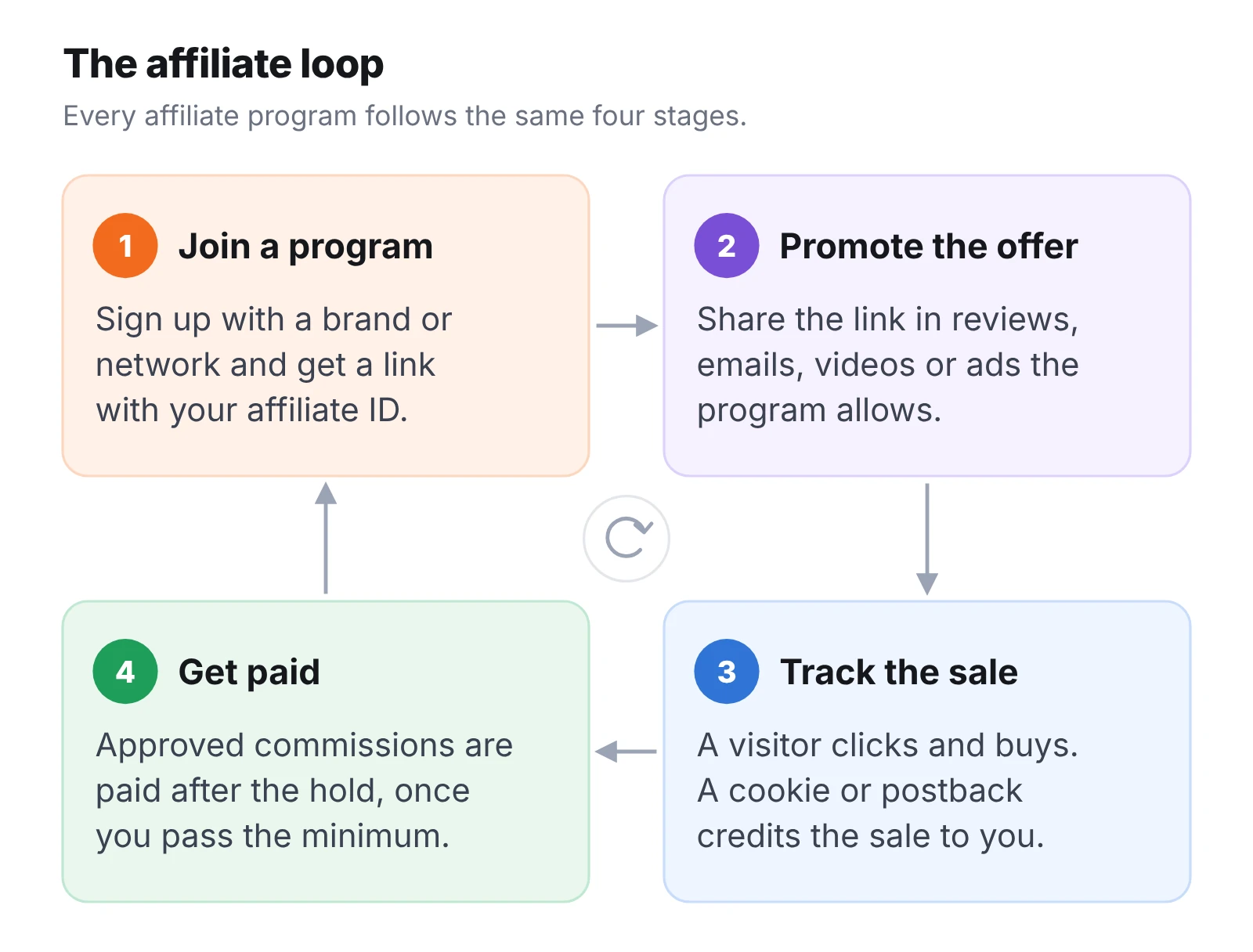
Here is the full cycle, step by step.
- You join the program. You apply directly with the brand or through an affiliate network. Some programs approve instantly, others review your website or traffic sources first.
- You get a unique tracking link. The affiliate link contains your ID (for example
?aff_id=1234). Some programs also give you promo codes, banners or landing pages. - You promote the offer. You place the link in a review, comparison table, newsletter, video description or ad, using only the traffic sources the program allows.
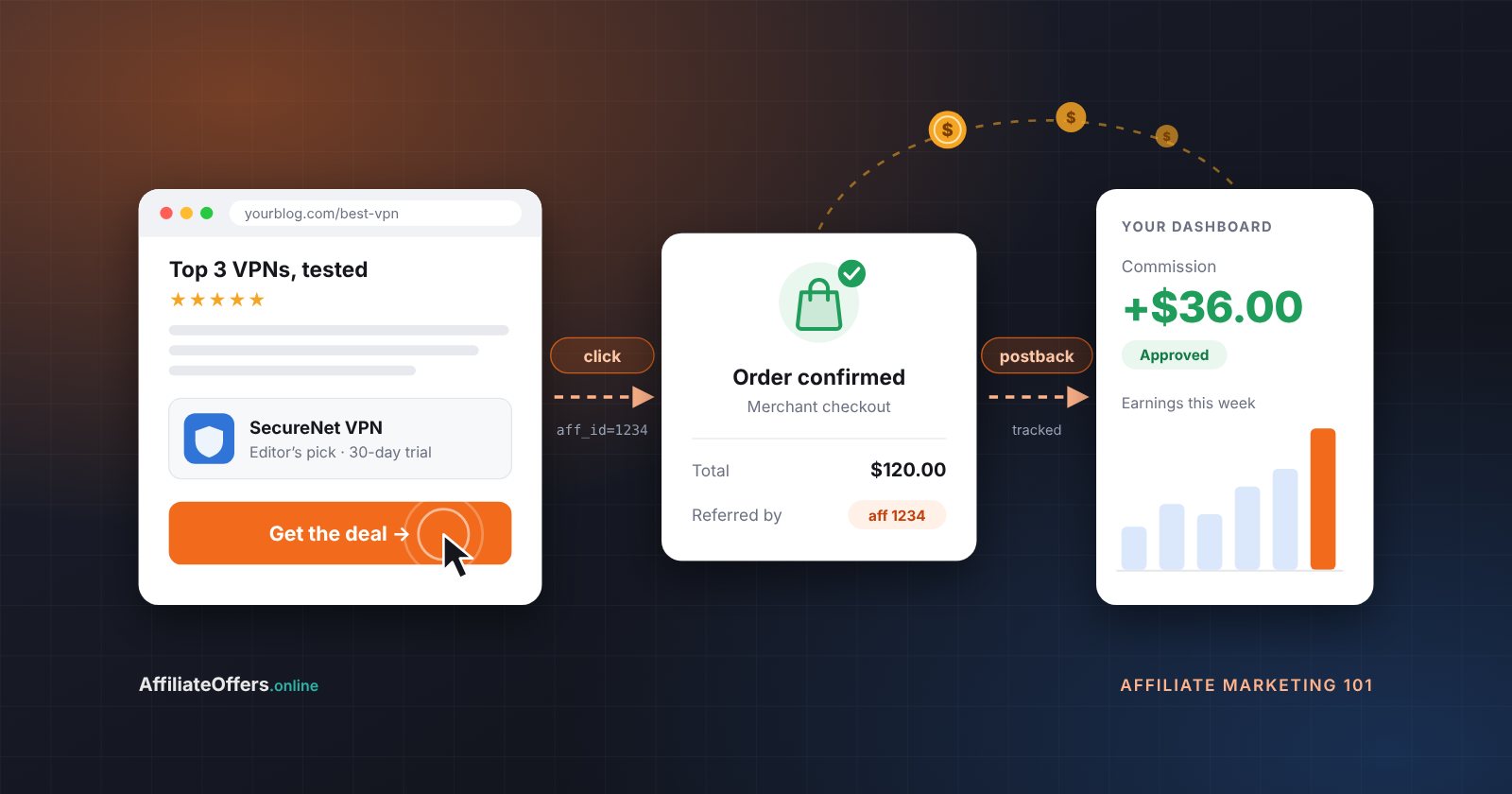
- A visitor clicks. The click is recorded and a cookie (or a server-side click ID) is stored. It remembers you for the length of the cookie window, often 30, 60 or 90 days.
- The visitor converts. They buy, register, deposit or fill in a form, depending on the offer.
- The conversion is tracked. The merchant's system reports the result back to the tracking platform, usually with a postback (a server-to-server call) or a tracking pixel. It is assigned to your ID.
- The conversion is validated. Refunds, chargebacks, fraud and duplicate leads are removed. This hold period can take days or weeks.
- You get paid. Once your balance passes the minimum payout, the program pays on its schedule (weekly, bi-weekly or monthly) via bank transfer, PayPal, Paxum, crypto or another method.
That is the whole loop. Everything else in affiliate marketing — commission models, networks, compliance — is a variation on these eight steps.
How affiliates get paid: commission models
The commission model defines which action pays and how much. Every offer on AffiliateOffers shows its model, so it helps to know them.
| Model | You are paid for | Typical verticals | Good to know |
|---|---|---|---|
| CPA (cost per action) | A defined action, such as a sale, deposit or trial | Software, finance, gaming | Fixed amount per action, simple to compare |
| CPL (cost per lead) | A valid lead, such as a form or registration | Dating, insurance, education | Lower payout, easier conversion; lead quality is checked |
| CPS (cost per sale) | A completed purchase, usually a % of the order | E-commerce, nutra, physical products | Earnings grow with basket size |
| RevShare (revenue share) | A % of the revenue the customer generates over time | iGaming, adult, SaaS subscriptions | Recurring income, slower start; check lifetime vs. limited terms |
| PPS (pay per sale / signup) | Each paid signup, a fixed amount | Adult paysites, subscriptions | Common in adult programs |
| Hybrid | A CPA plus a smaller RevShare | iGaming, trading | Upfront cash plus long-term income |
Affiliate program vs. affiliate network
An affiliate program belongs to one brand. An affiliate network is a marketplace that hosts offers from many brands under one account.
| Affiliate program (in-house) | Affiliate network | |
|---|---|---|
| Offers | One brand's products | Hundreds or thousands of offers |
| Sign-up | One application per brand | One account, then apply to offers |
| Payouts | Separate balance and minimum per brand | One combined balance |
| Support | Brand's own affiliate manager | Network's affiliate manager |
| Best for | Going deep on a brand you know converts | Testing many offers fast |
Many affiliates use both: networks to find what converts, then direct programs to negotiate better terms. On AffiliateOffers you can browse affiliate programs and affiliate networks separately, and each offer shows where it runs.
Traffic sources and program rules
Every program lists which traffic it accepts. Breaking those rules is the fastest way to lose your commissions.
- SEO and content — reviews, comparisons and guides on your own site. Accepted almost everywhere.
- Email — often allowed only to opt-in lists; spam is banned.
- Social media and video — usually fine, but some brands restrict paid boosting.
- Paid search (PPC) — many programs ban brand bidding (bidding on the brand's own name).
- Push, pop and native ads — common in dating, adult and sweepstakes; mainstream brands often refuse them.
- Incentivized traffic — users rewarded for converting. Allowed only where the offer says so.
Programs also limit GEOs (the countries they accept). A lead from a non-accepted country usually earns nothing.
Pros and cons
| For affiliates | For merchants |
|---|---|
| No product, stock or support to handle | Pay only for results, not for impressions |
| Low cost to start with content or SEO | Reach audiences they could not buy directly |
| Work with many brands and verticals | Scale through hundreds of partners |
| But: income is not guaranteed, rules change, and programs can close or cut payouts | But: fraud and low-quality traffic must be monitored |
How to start
- Pick a niche you understand and an audience you can reach.
- Choose one traffic source and learn it well before adding others.
- Browse affiliate offers and programs by niche.
- Read the terms: allowed traffic, GEOs, cookie window, hold period, minimum payout.
- Start small, track EPC and conversion rate, and scale what works.
FAQ
What is an affiliate in simple terms?
A partner who promotes another company's product and gets a commission for each sale or sign-up they bring.
Is affiliate marketing free to join?
Most programs and networks are free for affiliates. Your costs are your traffic: time for content, or budget for ads.
How long does it take to get paid?
It depends on the hold period and the payment schedule. Commonly from one week to two months after the conversion.
Do I need a website?
Not always. Many programs accept email, social or paid traffic. A website does make approval easier and gives you long-term SEO traffic.
Keep learning
This is the first article in our learning hub. Next up: CPA vs. RevShare, how tracking and postbacks work, and how to choose an affiliate network. For quick definitions, browse the affiliate marketing glossary.